
Practical guide
Count layouts before pricing a mixed fleet
Group vehicles by verified configuration and coverage rather than assuming one brand means one production layout.
Read the guide: Count layouts before pricing a mixed fleetChicago commercial vehicles & fleets
Bring different vans, trucks and cars into a clear fleet scope. Group the actual configurations before repeating the design.
Guaranteed response within 2 hours.Free planning tools and buyer downloads below.
A clear scope before the spend.
Free mixed fleet scope builder below. Use the result with any wrap shop.
More useful project detail
Count distinct configurations and coverage choices while preserving the exceptions that matter to production and purchasing.

A visual you can keep
Count configuration and coverage groups without losing individual history.
Use the planning example from Chicago Fleet Wraps, download a copy, or read the related project guides.
Practical guide
Group vehicles by verified configuration and coverage rather than assuming one brand means one production layout.
Read the guide: Count layouts before pricing a mixed fleetPractical guide
Decide which differences should disappear and which serve a documented business purpose.
Read the guide: Distinguish brand inconsistency from intentional fleet variationPractical guide
Use individual notes for repairs, old graphics and unknown history without losing the usefulness of grouped planning.
Read the guide: Keep vehicle condition exceptions visible in a mixed-fleet quoteWhy put your business on a vehicle?
Keep the important colors, wording and identity consistent across the vehicles.
Keep vehicle and artwork records so the next unit starts from an agreed reference.
Plan batches, approvals and vehicle availability before agreeing the rollout.
A clear scope before a price
Vehicle size, covered areas, artwork, preparation, existing graphics and the proposed material system all belong in the price discussion.
Useful when the priority is a clear name, service and contact route.
Discuss this scopeCompare the exact panels, message and finish with the full-coverage option.
Discuss this scopeConfirm the included painted panels and any exclusions on the actual vehicle.
Discuss this scopeRequest a price for the actual vehicles and agreed coverage. The free tools below help you compare the assumptions.
Picture the possibilities
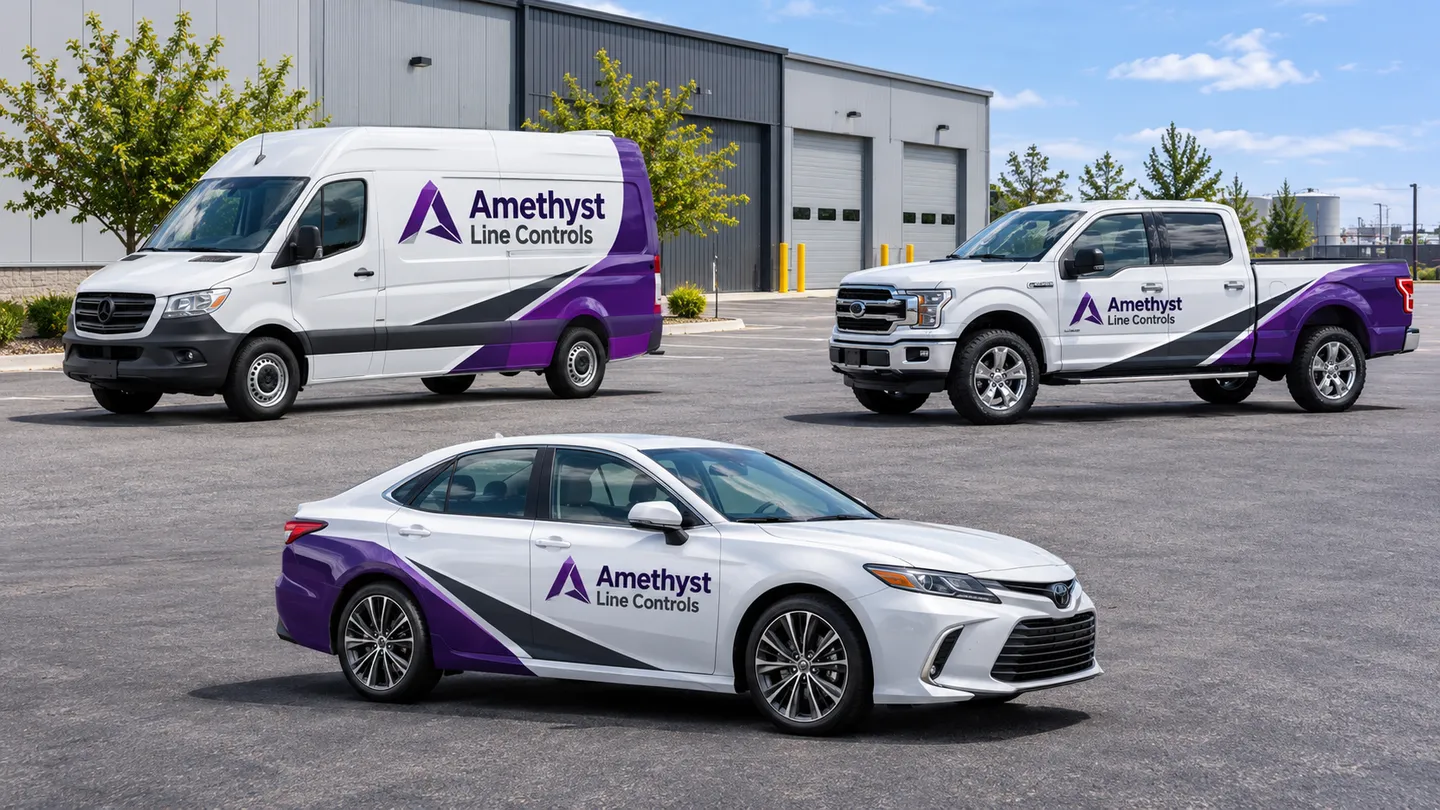
Look at the message, the coverage and the working views.
Amethyst Line Controls is a fictional business. These generated design concepts illustrate ideas to discuss for your vehicles.
Plan the graphics for your vehiclesLet’s talk vehicles
Tell us how many vehicles you have. We’ll follow up about the vehicles, coverage, design and timing.
Guaranteed response within 2 hours.Know the next step
Guaranteed response within 2 hours. Final project pricing and dates follow review of the scope.
Name, email, phone and vehicle count. Share the project context through the free tool if it is useful.
Discuss the actual vehicles, coverage, artwork, existing graphics and timing.
Check the written scope and vehicle-specific artwork, including the business wording and included surfaces.
Confirm scheduling, preparation, review and the applicable care information.
The free tool
Use the example values to explore, then replace them with your project details.
One vehicle per line: ID | exact body configuration | proposed coverage
Use the tool without sharing contact details. Entering a valid email or phone in the inquiry form saves your project entries, filenames, analysis and selected original files, even if unfinished. Original files: up to 50 MB each and 200 MB per batch.
Vehicle body and coverage differences remain distinct.
| Configuration / coverage | Count | Vehicle IDs |
|---|---|---|
| Transit high roof | Partial wrap | 2 | V-01, V-02 |
| Box truck | Sides and rear | 1 | B-01 |
Grouping organizes the inquiry. Confirm actual vehicle dimensions and approved artwork for each configuration.
Ready to discuss the vehicles? Get fleet pricing. Save your result to use in that conversation.
Free tools for a better buying decision
A 12-page workbook with generic wrap concepts and fillable worksheets for coverage, quote comparison, budget, fleet availability, artwork, proof approval and vehicle records. Use it with any wrap shop.
Fill it in electronically or print it. No email needed.
Take this to any wrap shop
Print it off so you remember to ask. A practical checklist covering scope, materials, artwork, preparation, scheduling, warranty and handoff, plus questions for this project.
Confidence comes from the details
Use these checks when you review a proposal, a proof or a wrap shop. Keep the answers with your project.
Print the wrap-shop questionsSee the tradeoff
Two matching Transits group together, while the box truck remains a separate layout discussion.
Illustrative values, not a completed customer project.
Vehicle body and coverage differences remain distinct.
| Configuration / coverage | Count | Vehicle IDs |
|---|---|---|
| Transit high roof | Partial wrap | 2 | V-01, V-02 |
| Box truck | Sides and rear | 1 | B-01 |
Grouping organizes the inquiry. Confirm actual vehicle dimensions and approved artwork for each configuration.
Leave with something useful
Group vehicles by body configuration and coverage so the mixed fleet has a clear project scope.
Organize my mixed fleetBuild it from the project details you enter.
Keep the assumptions and open questions visible.
Copy, save or print the result for your next conversation.
Commercial wrap service
For a mixed fleet graphics project, inventory the exact vehicle configurations, record existing graphics and visible condition concerns, and identify which brand elements should become consistent. Group similar vehicles while preserving meaningful differences. Keep unknown details marked so the next discussion can address them without relying on assumptions.
A fleet can grow through replacement purchases, acquisitions, new services, and changing equipment. The result may be several body styles, old logo versions, and different contact details working side by side. Before deciding how to standardize those vehicles, document what is actually there. This guide helps a business prepare a mixed-fleet graphics inquiry using a clear inventory, useful photographs, and a distinction between genuine vehicle differences and inconsistent branding that the business wants to address.
A familiar model name may describe vehicles with different lengths, roof heights, doors, windows, or equipment. Record the configuration of the vehicles actually in your fleet and connect photographs to the correct identifiers. Include racks, toolboxes, rear steps, or other features that may affect the graphics conversation. Where information is incomplete, ask a local contact to confirm it instead of choosing a specification from memory. An accurate inventory helps the project discussion account for real differences without treating every vehicle as an entirely separate branding project.
Photograph what is currently on each vehicle, including outdated logos, missing sections, old contact information, and areas that have been repaired or repainted. State what you know about the vehicle history and what you cannot verify. These notes support a discussion about removal, preparation, and the proposed scope; they do not replace an assessment of the actual surfaces. Keep condition observations factual instead of assuming a visible mark is harmless or that previous graphics can simply remain underneath a new design.
Collect the current business identity and decide which older versions should be retired. Define the shared company name, service wording, and contact priorities before considering the individual vehicle layouts. Record exceptions that serve a business purpose, such as different operating divisions or unit identifiers. Do not preserve an inconsistency merely because it appears on one vehicle, and do not remove a meaningful difference without asking why it exists. This gives the artwork conversation a clear standard while respecting the practical variety in a mixed fleet.
Buy with the questions answered
Yes. Shared colors, typography and messages can connect a fleet while placement is adapted to each body. Group the vehicles by configuration and review each layout before repeating it.
Guaranteed response within 2 hours. The next conversation confirms the vehicle details, proposed coverage, artwork, existing graphics and timing so a project-specific scope can be discussed. Sending an inquiry does not reserve an installation date.
Review the covered surfaces, final business wording, vehicle-specific artwork, proposed material system, preparation and removal needs, price exclusions and agreed handoff. The free wrap-shop questions give you a record to use with any supplier.
Before you decide
For project-specific help, use the four-field inquiry form.
Get fleet pricingDifferences in body configuration, equipment, existing graphics, and business role can all matter to the planning discussion. Record them without deciding their technical impact yourself. Photos and stable vehicle identifiers help the project contact ask specific follow-up questions instead of working from an incomplete model list.
Read the detailed guide: Keep vehicle condition exceptions visible in a mixed-fleet quote
Yes. Show the current graphics and explain which identity the business intends to use going forward. Include known removal or surface-condition questions. Older branding is useful project information, but it should not be mistaken for the approved reference if your business has already adopted a newer identity.
Read the detailed guide: Distinguish brand inconsistency from intentional fleet variation
A business can discuss shared brand elements while acknowledging differences in available panels and vehicle configuration. Identify the logo, message, and contact details that should remain consistent. The artwork conversation can then consider how those priorities translate to the actual vehicles rather than assume an identical layout.
Read the detailed guide: Count layouts before pricing a mixed fleet
Mark the history as unknown and provide clear photos of any areas that raise questions. Ask the person responsible for the vehicle whether records are available. Do not present an uncertain surface condition as confirmed; keep it visible as an item for the project discussion.
Read the detailed guide: Keep vehicle condition exceptions visible in a mixed-fleet quote
Carry common colors, typography and messages across the fleet, then adapt placement to each vehicle. A layout that works on a trailer may need substantial changes on a cargo van.
3M sourceUnpainted or textured plastic, rubber and silicone need separate evaluation. 3M's vehicle guidance excludes or limits several of these surfaces for the films covered by that guidance.
3M sourceNew paint must cure according to its manufacturer's instructions. Flaking paint, repairs and unsound finishes need assessment before installation or removal; a wrap is not a repair for failing paint.
3M sourceA damaged graphic may be assessed by complete component. Weathered material can differ in color and gloss from new prints, so a replacement panel should be reviewed alongside the remaining graphics.
3M sourceFor mixed fleets operating around Chicago, share the vehicle locations and confirm how each proposed group would be handled. Tell us about your vehicles.